⛵"Writing is traveling without the nuisance of the luggage." - Captain Emilio Salgari | 🐯 You may reupload/repost/etc. these translations wherever whenever. Thank you for ALWAYS linking back to my blog and giving credit where credit is due. ⚔️🐯⛵
NONE OF THESE TRANSLATIONS ARE MADE BY PUTTING THE STORIES IN THE AI AND THEN PASTING THEM FROM CHATGPT ONTO HERE. I DO NOT ALLOW FOR MY TRANSLATIONS TO BE USED FOR AI TRAINING.
Tales From The Little, Illustrated, Golden Library - Tales of the Sea - The Corsair Of The Red River - Emilio Salgari - Third Story
Get link
Facebook
X
Pinterest
Email
Other Apps
-
THE CORSAIR OF THE RED RIVER
VOCABULARY
corsair = pirate.
Mandarin = a bureaucrat of Imperial China (original meaning of the word). Source (24.07.2025).
Mandarin is a term used for bureaucrat scholars in the history of China, Korea, and Vietnam.
The English term comes from the Portuguese word mandarim (spelled mandarin in Old Portuguese), with influence from Malay and Sanskrit and its literal meaning is "possessor of sacred knowledge".
jetty = a landing stage or small pier at which boats can be docked or be moored.
gilt = gold coating (noun); or gold plated/gilded (adj).
awning = a sheet of canvas or other material stretched on a frame and used to keep the sun or rain off a storefront, window, doorway, or deck*.
*deck = the floorlike covering of the horizontal sections, or compartments, of a ship or boat. Small vessels have only one deck; larger ships have two or three decks. (Source. 15.01.2026)
loyalist = person faithful to a (specific) leader.
bow = above waterline (nautical term)
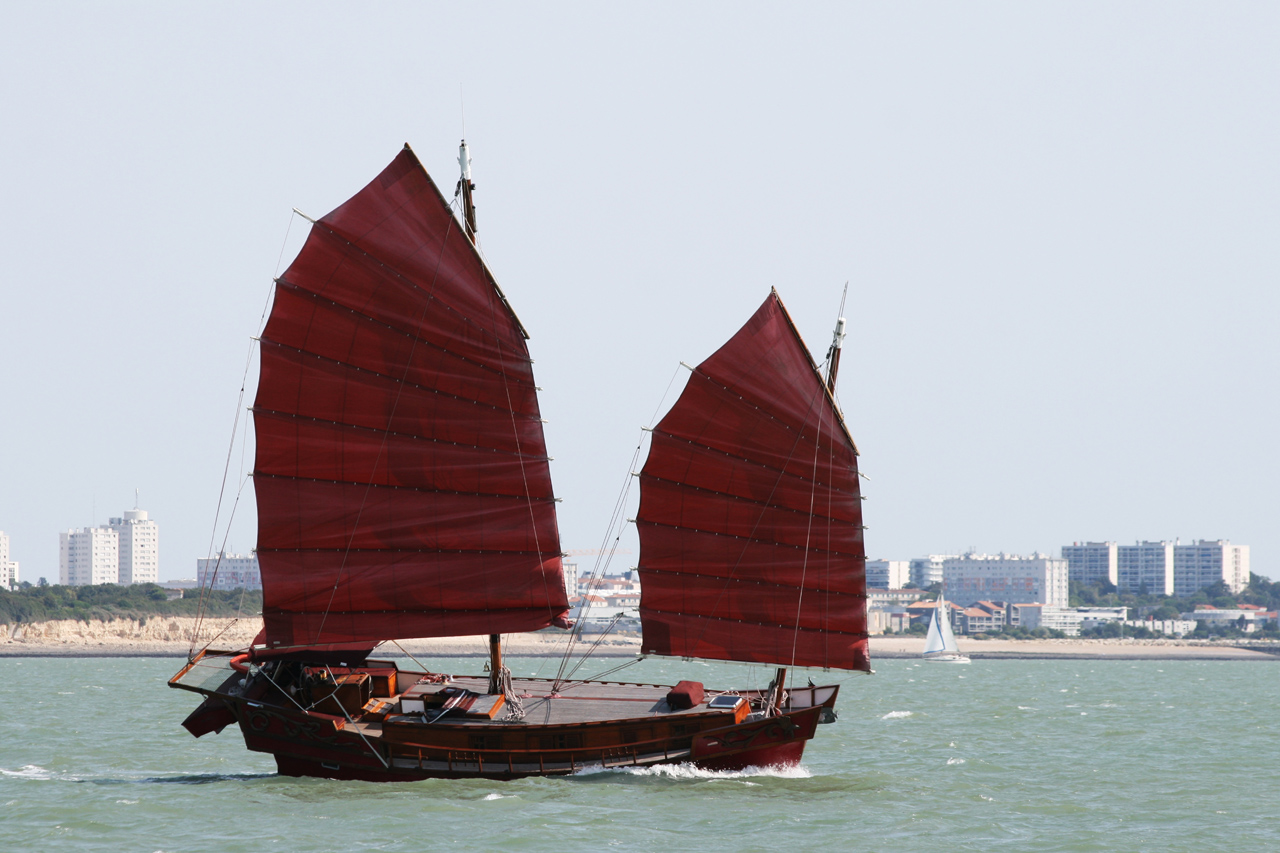
junk = nautical term for a type of Chinese sailing ship. Source (25.07.2025). The term comes from the Portuguese word, junko, whom originally comes from the Old Javanese term joṅ, which means "ship".
bulwark (nautical) = the planking or plating along the sides of a nautical vessel above her gunwale that reduces the likelihood of seas washing over the gunwales and people being washed overboard.
The following text may present outdated depictions that are in no way or form shared by the translator themself, and neither are they shared by the original author of these stories.
Please understand that these stories' depictions are a depiction of their time.
A good translator strives to transfer the originality, tone, and idea of a text from its language of birth to its guest language, all the while respecting the intent and style of the original author.
These translated texts do not intend to bring offense, but just to share the adventures
written by Captain Emilio Salgari.
Adventures inspired by his love for traveling around the world, especially to far, foreign lands, his passion for ships and sailing in general, as well as his endless curiosity about other cultures and what's out there, beyond the horizon line.
DISCLAIMER:
The following translation is related to a time when Opium Wars were waged. For a more in-depth research of the topic, you can go here. For a brief history, you can check out the following video:
The author of this blog does NOT condone nor endorse the use of any kind of mind-altering or mind-numbing (chemical or natural) substances in any way or form.
This is but a translation of a story that Captain Salgari wrote during his lifetime: the story of a (supposedly real) man from far away seas and lands.
Thank you for understanding.
🌉
Sinkio! In 1889 this name was more than enough to inspire terror inside the hearts of the population that lived on the Southern coast of Tonkin*.
There were many terrible tales surrounding the man that carried that sinister name, because Sinkio was renowned as the most horrendous corsair to ever command the Red River.
Having arrived precisely at that time in Saigon**, the capital of the French Cochinchina***, I, too, had heard about him, not just from the sailors that would hang out habour, but even from the French authorities.
Nosy as always, I couldn't help but immediately ask for information about this man that was spreading such profound terror that year inside the waters of Tonkin.
However, I had received nothing but vague answers. "He's a formidable pirate", some would tell me, while keeping an eye on their surroundings, as if they feared someone overhearing them; "he's an avenger", others told me while trembling with fear. I couldn't get much more than that.
It was as if everyone feared saying as much as one more word about this terrible man.
One day, after an an extremely lavish meal cooked by a Mandarin to whom we had brought a large quantity of salt that we had taken on board from Guangzhou on his behalf, the conversation shifted to Sinkio and, seizing the opportunity, I asked our host for more information about the corsair.
The answer that I had been met with was so surprising, that it had left me speechless.
"Would you like to meet him?"
Before I give him my answer, doubt had already made its nest inside my mind. Just as my curiosity was great, so was my sense of caution, a bit of dread joining it.
What if that corsair, so feared by everyone, suddenly got the bright idea of taking me as a prisoner and then demanded a great ransom in exchange?
The Mandarin, amused as he watched me processing what he had just said, most likely had guessed in what direction my thoughts were heading, because he rushed to add:
"Oh! Don't you worry about it! You're not Chinese, so you're safe from Sinkio's deep hatred."
"Could it be that that man isn't as terrible as they say?"
"He is terrible, but only towards the Chinese."
"Just towards the Chinese? What for?"
"Come by my house in the evening, and I will recount everything to you; and, if you'll want to, afterwards, we'll go visit Sinkio."
"And just how will we find this man?"
"He's a lot closer than you might think."
"And he doesn't get caught?"
The Mandarin smiled a mysterious smile.
"Why catch him?", he answered me. "He's not dealt any damage to the French colony."
Then he sent me off:
"See you in the evening!"
I patiently waited for the sun to set, not without a few palpitations, though, as I had a lot of anxiety regarding the upcoming visited suggested by the Mandarin.
As soon as night fell, a servant of the Mandarin came to get me and guided me to a jetty where there was one of those big boats loaded with intaglio carvings, and gilts, called sampan around there, waiting for me.
The Mandarin was waiting for me under an awning that was on the central part of one of those rich boats, held up by small, gold gilded pillars, adorned with a blue, silken pavilion, and crimson velvet cushions.
"Do you want to go out at sea?", the Mandarin asked me. "I will have you witness to a cruel show because tonight is the night when Sinkio will kill his foe."
"Does that mean that there is going to be a fight?"
"He's raging, because Tokio, knowing that the former is a wanted man, called to arms all of his loyalists and armed his junks to the teeth.
"Who is this Tokio, anyway?"
"Sinkio's enemy."
"I now know something more than I did a minute ago, but that still doesn't enlighten me."
The Mandarin, instead of answering me, offered me a conical-shaped cigarette full of fragrance, lay down on the crimson velvet cushions as he invited me to do the same, and gave the signal for the departure.
The sampan, under the vigorous push of twelve oars, descended on the turbid waters of Mei-King****, surpassing the numerous ships still docked at the port and then sped out to open sea, veering towards the Eastern coast.
A deep calm reigned outside of the port and the river. The sea, almost as smooth as a mirror, faintly mirrored the rays of the moon.
From the seaboard, which was covered in trees, piercing fragrances reached us, while a cool breeze would blow from the the open sea, dissipating the smoke from our smokes.
I was quietly going over the oddness of this adventure. Faint restlessnesses were distressing me, not putting too much trust in that Mandarin that I had known for a mere forty-eight hours.
I was beginning to suspect that he might have been a buddy of that fearsome corsair and that he had taken advantage of my curiosity in order to lure me in some kind of trap.
Suddenly, the voice of the Mandarin snatched me away from those reflexions.
"You wished to know Sinkio's story, did you not?", he addressed me. "I have the time to recount it to you, given you are willing to hear it."
Although I found his timing less than oportune, what with the restlessnesses and all that were tormenting me, my imperishible and invincible curiosity for amazing adventures got the best of me, and therefore answered him that I would gladly listen to the story.
"Most believe that", began the Mandarin, "that Sinkio is nothing more than a coarse pirate when, in reality, he's an avenger; and the French authorities are aware of that because not even once had they tried to hunt down his junks, despite the fact that they frequently show up around these seacoasts.
"Sinkio put fear in the heart of every Chinese establish in Tonkin, but not even once had he laid his finger on a Tonkinese, much less on an European.
This is his tale.
Ten years or so ago, the Chinese government banned the admission of opium in its immense empire, that terrible narcotic that in a short amount of time brings to ruin even the sturdiest of men, once they become accustomed to smoking it.
Sinkio, at the time, was nothing but an honest shipmaster, whom, with his junk, did business between China and Japan, importing especially opium.
His trades ruined by the edict of the Chinese government, decided to become a smuggler.
Despite the edict, he would go and take on board opium from Yokohama and would bring it in China's harbour.
A military Mandarin, a former pirate somewhere in his far away past, having reached such a high position probably thanks to his roguery, had sworn to capture the bold smuggler and subject him to the worst of the worst tortures.
One sombre night, having found out that Sinkio was supposed to unload some opium in the port of Guangzhou, expected him at the mouth of the Pearl River with two large ships, and as soon as he caught sight of the smuggler's junk, wrathfully bombarded him.
But Sinkio's men were valiant and tenacious. He accepted the fight, sunk one of the enemy ships with a bunch of cannon shots and manages to capture the Mandarin.
Any other man would have rushed to hang him, or at the very least, tie a cannonball to his leg and throw him into the sea.
But Sinkio was as chivalrious as he was courageous. He forces the Mandarin to swear that he will leave him alone and let him be, to never meddle in his affairs ever again, and disembarks the Mandarin safely ashore.
If Sinkio had proven himself to be generous, the Mandarin, on the other hand, was furious that he had been defeated by the smuggler, while disembarking.
Disregarding completely the oath he had just made, once he had made it back to Guangzhou, imprisons the men that had escorted him back, and beheads them after he had subjected them to atrocious tortures; then, after having found out where the smuggler's wife and their three kids lived, has them hanged at Boccatigris' lighthouse, where Sinkio could see them at his first docking, and forbiding anyone from taking them down.
This was the answer to the generosity, certainly not well-timed, of the poor smuggler.
War was now confirmed between Sinkio and the Mandarin.
The smuggler arms a new junk, equips it with men that fear nothing, and with unheard of audacity, declares war to the entire Chinese Empire.
They were sixty men against three hundred and fifty millions men; and yet, Sinkio holds his own against all war junks sent to capture him.
With lightning quick escapes he retreats from battles that are too dangerous, but swoops down on defenseless, coastal small towns and destroys them as he brings despair to all, then, when he feels that he has avenged himself enough, trades the waters of China for the waters of Tonkin.
But, a man hadn't yet forgotten about him nor had he abandoned his pursuit of him: the Mandarin. He had sworn to avenge his defeat and had kept true to his word.
Now, he's learned that Sinkio has taken refuge in a small bay of this coast, tonight he will attack him, and we will assist to an incredible battle."
"Who will win?", I asked.
"They both have valorous men, two ships that are equally well-armed, and both of the two antagonists have courage that was forged in fire. Fate will be the one to decide."
Meanwhile, the sampan kept moving East, keeping itself in the line of sight of the beach, the latter being highly visible thanks to the plants with tall trunks.
We had traveled ten miles by then, when the Mandarin had brought to my attention two bright lights that were sparkling against the sea.
"The headlights of a ship?", I asked.
"The ones belonging to the junk of the Chinese mandarin.", he answered me.
"They don't seem to be moving.", I pointed out.
"Quite right. You see, the Mandarin doesn't dare attack his enemy while the latter's still in the bay, for he fears shallow waters, and so, he awaits him in the open sea."
"Is he going to open fire on us?"
"We will pass by unseen and then be out of range."
"But your friend might mistake us for spies of the Mandarin and greet us with a cannonball, an experience which I could really do without."
"Sinkio will catch on that we're here as friends."
He gave a few orders to his men. Presto, a lantern of great width, made from wax paper was lit up on the top of the central awning, and a smaller, green one afterwards.
Once that was done, the sampan quickly drew near land, spinned around the farthest point, and entered a small in whose center I could faintly dinstinguish a big and black mass.
"It is Sinkio's junk", the Mandarin told me.
"Are we going to board it?"
"Yes, if you have no objections, that is."
At this point, I couldn't both pull back and keep the respect that would come with being an European. Relying on the integrity of both the Mandarin and smuggler, I assuredly accepted the offer.
Plus, I was quite eager to meet the man that had defied, with just a handful of men, the most populous empire on Earth, if not the most powerful too.
We crossed the bay and when we were within an arrow's shot of distance from the junk, we heard one of sentries inquire:
"Who goes there?"
"Ping, the Mandarin.", answered the man that was accompanying me.
"You may go forward."
We boarded the junk near the bow and immediately we were tossed a rope ladder.
"Go ahead and climb.", the Mandarin told me.
I conquered the last of my fears, and climbed up on the side of the junk, going over the railing that was on the bow.
Some men, armed with lanterns, surrounded me, eyeing me suspiciously.
Their height was that of a giant, their appearance some of the fiercest I had seen, and over their overalls they were sporting rusty iron mails and, on their heads, helmets made of steel that depicted fearsome heads that would strike fear in one's heart.
On their belts, they were sporting a type of sword that the Japanese called katana, with a wide blade, straight, and as sharp as a razor.
"He's a friend of mine", stated the Mandarin, when he noticed that those men wouldn't cease staring at me in such a way that, really, it was encouraging for me up to a certain point. "Where's your boss?"
"On the stern", we were answered.
The Mandarin took me by the hand and led me across the ship.
That junk was a powerhouse of a sailing ship, with its massive forms, its highly tall bow, ornamented with huge dragons that were painted using the red colour, and a spacious stern.
These unsafe and terrible sailers, are used by all of the Chinese people and even by the Tonkinese, often undertaking lengthy voyages but every year many of them end up sinking.
On that that belonged to the smuggler, there were quite a few cannons, some large blunderbusses, and falconets, and, hanging on the wall, there was every kind of blade that existed.
Once arrived on the stern, the Mandarin introduced me to a man entirely covered in plates of iron, an armour typical of the Ancient Japanese, his height short, plump, and strong-limbed.
There was nothing menacing in his gaze, on the contrary, his slant and small eyes held a benevolent glow.
Seeing me, the famous corsair offered me a friendly smile and after exchanging a few words with the Mandarin in a language that I couldn't understand, extended his hand to me, telling me in a pretty decent French:
"Sinkio sends his regards to you and is happy to have you on his ship. This may be the last time you will ever see me."
"Is it true that in a short while you will attack the junk of your sworn enemy?", I asked him.
"Yes", the smuggler answered me, as his a fire lit up in his eyes. "It's been two years since we are hunting the other down in order to exterminate one another and since the opportunity has finally presented itself, I will finally avenge the extermination of my family."
A deep sigh rose from the sturdy chest of the smuggler, while, I noticed, his eyes became wet. Recalling that memory pained him profoundly.
"Will you not give your enemy a single break?", I asked.
Sinkio raised one of his arms and pointed to the masts of the ship.
"Take a look", he said.
I rose my eyes and, as shiver went down my spine, saw an iron ship cross beam bristling with spikes, resembling a comb.
In front of it, on the foremast, there was another, and, in the middle, there was sturdy rope hanging from the pulley.
"What could you possible use those for?", I asked.
"Do you still not understand?", answered Sinkio with a tigerish smile.
"I fear saying it out loud."
"It's for my enemy: just wait until I get my hands on him, and I will have him fly from one comb to the other."
"Be merciful; kill him, it's within your right, but don't subject him to barbarical tortures."
"Where was his mercy when had murdered my sons? Did he not murder my wife, too? No, an eye for an eye, a tooth for a tooth, and a head for a head. Goodbye, Sir, I am off to roll the dice."
He extended his hand to me one more time and then motioned for me to return to the sampan.
A moment later, we were disembarking on land on the far end of the bay, under the thick shadows of a clump of spotted mangroves***** whose twisted roots were watering themselves inside the salty waves.
"We'll stay here.", the Mandarin told me. "It wouldn't be wise to go on out on the high seas, seeing as cannon balls will be flying everywhere."
"Who will victory smile upon?", I asked.
"It will smile upon the Corsair of the Red River", he answered me. "He's stronger and more valiant than the Mandarin, as well as more determined than him. Tomorrow, that unfortunate Mandarin will be tasting the spikes of those terrible combs."
Meanwhile, the junk had spread the sails, raised the anchor and lit up from the bow to the stern.
An endless number of torches were tied to the bulwarks, so much so that we could discern Sinkio and his corsairs, whom were busy loading the cannons and making all the other preparations necessary for the boarding.
The junk of the Mandarin, as well, covered itself in fire and was quickly sailing towards the bay in order to prevent the corsair of the Red River from sailing out to sea.
Shortly after that, we heard the noise of the first cannon shot, immediately followed by another.
They had each answered the other.
After those initial two shots there was a brief silence, then the cannons started thundering once more, in a frightful crescendo.
Yards and fragments of masts were falling down, nonetheless the two junks continued to speed up towards each other, both seemingly eager to sink the other one.
Among the rumbles of the cannons and the bangs of the gunshots, from time to time we could hear the war cries and laments of death of the combatants.
The two enemies seemed worthy of each other and their men proved to be no less.
Of course, the Mandarin, too, had brought with him the bravest men of Guangzhou, because, generally, the Chinese men cannot stand continuous fire for long, this making them terrible fighters in such a situation.
The corsair's fighting skills were magnificent and his maneuvering of his junk extraordinary; the Mandarin, too, proved to be a man of courage as well as a skilled sailor.
Eventually, we saw that the two junks had reached one another. Above them, it looked as if a big jet of fire was passing over them both.
The collision between them had been so tremendous that we could distinctly hear the rumble caused by the crashing of the wooden boats into each other.
What came next? For a few moments, there was a succession of screams and gunshots, succeeded by the extinguishment of the torches by themselves, after which we could no longer see anything.
It looked to us, though, as if one of the two junks had taken flight, because we could hear in the distance the rumble of some cannon shots that were becoming fainter and fainter.
Finally, all noise had ceased and the silence was no longer interrupted by anything but by the crashing of the waves against the monstrous roots of the spotted mangroves.
The Mandarin and I stood up, both of us being deep in the throes of anxiety. What become of the junks? Had they sunk to the bottom, taking their crews with them, or had they just distanced themselves?
I probed the Mandarin for more information.
"I assume that the Chinese, understanding that he was about to get caught by the corsair, sought to find a way to escape.", he answered me. "Those two ships were too big and too strong to sink from a single collision."
"Where do you think that the Chinese ran off to?"
"We'll probably find that out tomorrow.", he replied. "Sinkio will undoubtedly return."
We stayed inside the bay until sunrise without hearing a single cannon shot. When the sun popped up the sea was deserted, nor could any sail be seen on the horizon.
"Let's go back to Saigon******",the Mandarin told me. "If Sinkio's not dead, he'll send someone over to inform me."
We turned our attention back to boarding the sampan and four hours later we were at a stone's throw away from the capital of the French Indo-China*******.
Several days went by without hearing from Sinkio, nor from the Mandarin. I was starting to think that the former was dead, when, one morning, a Malaysian servant came to inform me that the Mandarin wished to see me.
I had assumed that it must've been some kind of news concerning our corsair friend from the Red River so I hurried to the Tonkinese's place.
"I had a talk with Sinkio last night", he told me, after he had offered me a cigarette and a cup of some kind of amber-coloured liqueur that is obtained from a type of palm tree********.
"He's still alive!", I shouted.
"Last night he dropped the anchor of the junk inside the bay, carrying with him his enemy."
"The Chinese Mandarin?"
"Yeah."
"Where had he captured him?"
"Sixty miles from here, after five days of dogged combat. Once the Chinese guy realized that he couldn't hold his own against Sinkio's men, far more courageous than his own, had taken flight after he had fended off the initial attack, even though his ship had taken quite the damage upon their collision with each other.
Sinkio, whom had decided to pursue him this time, was set on not allowing him to escape and prevent him from taking refuge in the ports of Southern China.
For five days and five nights those two bitter enemies hunted one another, until, on the evening of the sixth day, the Chinese, whose crew was exhausted, found himself forced to accept the battle.
The melee was awful, for, the Chinese, seeing that all was now lost, were fighting with the strength that desperation instills. Half of Sinkio's crew fell on the deck of the enemy ship, but he had finally taken possession of the junk and managed to capture the Mandarin still alive.
"So... did they kill him?"
"Last night, after he was subjected to the atrocious torture of the combs."
"And... what now?"
"The mission of the corsair has been fulfilled and he's now preparing himself to reach his wife and children."
"I don't understand.", I replied.
"You will, tonight", the Mandarin answered me. "Sinkio is waiting for us at the bay."
"Do you intend to have me witness some kind of horrifying torture?", I asked. "If so, I refuse to accompany you."
"No, because the entire crew that was aboard of the Chinese junk is now dead.",the Mandarin answered me again. "You have nothing to worry about."
He had me stay over for lunch and spoke of just about everything except for the corsair of the Red River, then, after the sun had set, we boarded the sampan that would lead us to the bay.
We wouldn't reach it until about 2 in the morning, due to the countercurrent caused by the ebb.
Just like the first time, I spotted the corsair's junk while anchored in the middle of the bay.
On the masts, on the bow, on the stern, and on the bulwarks a numerous amount of lanterns were lit up, as if some sort of celebration was being prepared.
When we had climbed up on the deck of the junk, to my deep amazement, there was an immense heap of wood right in the middle, which was taking a good amount of space on the deck.
The corsair greeted me with a smile.
He was wearing his warrior's gear and on his hips there were now two katanas instead of just one.
"I am happy to have been able to see you one more time before leaving forever.", he told me, grasping my hand. "You will let the French of Saigon know that Sinkio will never return to these places and that they will never about him again."
"Are you taking a long trip?", I asked him.
A smile was his answer, then, after a brief silence, spoke up again:
"My wife and children have been waiting for me for four endless years."
He shook my hand once more, hugged my companion, then asked us to climb back down into our sampan.
In that moment, I noticed that his crew, too, had all climbed down into lifeboats and were heading towards the land.
"Is he going by himself?", I asked the Mandarin.
"Yes.", he answered me.
"How will he maneuver his junk?"
"There is no need for sailors for the journey he is about to undertake.", he told. "Look!"
"The junk is on fire!", I shouted.
"And Sinkio is about to join his wife and children.", the Mandarin told me.
I watched him with both astonishment and pathos.
"Sinkio fulfilled his revenge and is now leaving for the world from which no one ever returns", the Mandarin added.
The junk was all aflame, distancing itself more and more. Waves of reddish smoke towered over it.
It sailed for another ten minutes, then I saw the fire suddenly go out.
The ship had sunk along with the corsair.
"Let's go back to Saigon", the Mandarin told me as he sighed. "It's all over now."
And so, we left that bay sad and silent, while the first rays of the sun illuminated the sea.
**Saigon is Present-Day Ho Chi Minh City. Source (24.07.2025).
***Cochinchina is a historical term for part of Vietnam, most commonly used to refer to the Southern region of the country. In this particular context, French Cochinchina refers to a colony of French Indochina that encompassed Mekong Delta (also known as the (South-)Western Region) and adjacent provinces in what is now the southern region of Vietnam, whose administrative capital was Saigon (present-day Ho Chi Minh City).
****I suspect that Captain Salgari is most likely referring to the Mekong River. Due to the differences that exist between languages, many terms end up misheard, mispronounced or mistyped, especially in a time where there weren't so many resources at hand.
*****The plants that fall under the category of Rhizophora are all salt-tolerant. In this tale, the exact true mangrove that Captain Salgari is referring to is the Rhizophora stylosa, which is native to China. Other names for it are spotted mangrove, small-tilted mangrove,stilt-root mangrove or red mangrove.
I do not recommend to call it red mangrove, as it may get confused with the another plant that belongs to the Rhizophora family: the Rhizophora mangle, also known as red mangrove, but whom is native to the southern portions of North America, the Carribean, Central America, and tropical West Africa.
****** Saigon is present-day Ho Chi Minh City. The current name comes from the country's choice to honour the revolutionary leader who had declared independence from French-colonial rule in 1945, and whom was the first leader of North Vietnam.
*******French Indochina or French Indo-China was a group of French dependent territories in Southeast Asia from 1887 to 1954. They are officially known as the Indochinese Union and after 1941, as the Indochinese Federation.
********In our current day and age, it is known as palmwine and it is made from the sap of various palm trees like the palmyra, date, and coconut palms. When it ferments, it becomes more amber in colour. If the wine is allowed to ferment for too long, it turns into vinegar.
It is said that the stories written by Emilio Salgari are stories he would hear from sailors, when he would go to visit the dock.
His best and most known work, "Sandokan, The Tiger of Malaysia" has been proven to bear resemblance to true historical facts, starting with the firstly-thought-of-as-fictional island, Mompracem (currently known as Kuraman Island), and with the strong impression that Sandokan is no other than a fictional representation of Syarif Osman, who ruled Marudu (north of Borneo) (I recommend you go here for more information about Sandokan or Syarif Osman. Miss Bianca has done a marvelous job in finding, gathering, and translating information about Salgari and his works, especially those concerning the character of Sandokan).
Going by this, I strongly suspect that all of Emilio Salgari's stories are based on true, historical happenings and people, the sands of time mercilessly erasing most of their traces.
Emilio Salgari's stories feature places from all around the world; many of them feature places as far as possible from Europe itself. It is not far fetched that a story from your own hometown might be present in one of his writings, regardless of how remote or unknown you might think it might be to others.
If you know how to find the original, historical, sources of any of the stories present on this blog or if you even recognize one of them here as a local, known story (or legend) to you, please feel free to contact me.
I would love to put both the story written by Salgari and the historical one side by side and not let these names become forgotten.
T H E S E A T I G E R S MEMO The following text may present outdated depictions that are in no way or form shared by the translator themself, and neither are they shared by the original author of these stories. Please understand that these stories' depictions are a depiction of their time . A good translator strives to transfer the originality, tone, and idea of a text from its language of birth to its guest language, all the while respecting the intent and style of the original author. These translated texts do not intend to bring offense, but just to share the adventures written by Captain Emilio Salgari. Adventures inspired by his love for traveling around the world, especially to far, foreign lands, his passion for ships and sailing in general, as well as his endless curiosity about other cultures and what's out there, beyond the horizon line. VOCABULARY carbine = a rifle with a short barrel. ( Source . 04.11.2025) slaver = a ship us...
A Hero of the Sea Vocabulary : ( sailing ) yard = a spar* that is perpendicular (or square) to the median plane of the keel** and masts of the vessel, and from which sails are set. ( Source 1 . 15.01.2026) ( Source 2 . 15.01.2026) * spar = a pole of wood, metal or lightweight materials such as carbon fibre used in the rigging*** of a sailing vessel to carry or support its sail. ( Source . 15.01.2026) **keel = a rigid, flat piece of material anchored to the lowest part of the hull of a ship to give it greater control and stability. ( Source . 15.01.2026) *** rigging = term used for the system of ropes, cables, and chains, which support and control the sailing ship's masts and sails. ( Source . 28.10. 2025). topgallant yard = the topgallant sail or yard of the foremast ( Source . Translator's Note: Pappafico is an old, almost archaic way to refer to what is nowadays known as velaccino ). royal yard = the royal yard or sail of the foremast ( ...
After posting the English version of the song, it seemed only fair to post the original, Italian opening of the Sandokan series from 1976. Note : The following video contains the standard, main theme song and an extended instrumental version. The full version of the Italian opening stops at 3:05. The English translation of the Italian lyrics that is present on this blog was done by me. Sandokan, Sandokan Più crudele è la guerra e l’uomo sa cos’è la guerra. (The more cruel war is, The more man understands how war truly is.) Caldo e tenero è l’amore e l’uomo sa cos’è l’amore. ( Warm and tender is the love, And man better understands what love truly is.) Giù dal cielo scende un tuono, tutto intorno un grande suono; (A thunder descends from the sky, Everything around roars;) nasce il seme dalla pianta: il grande albero adesso canta. (From the seed a plant sprouts: The big tree now sings.) Corre il sangue nelle vene, grande vento nella notte calda si alzerà! (Blood rushes throug...


Comments
Post a Comment
Is what you are going to write something kind, necessary, or true?